

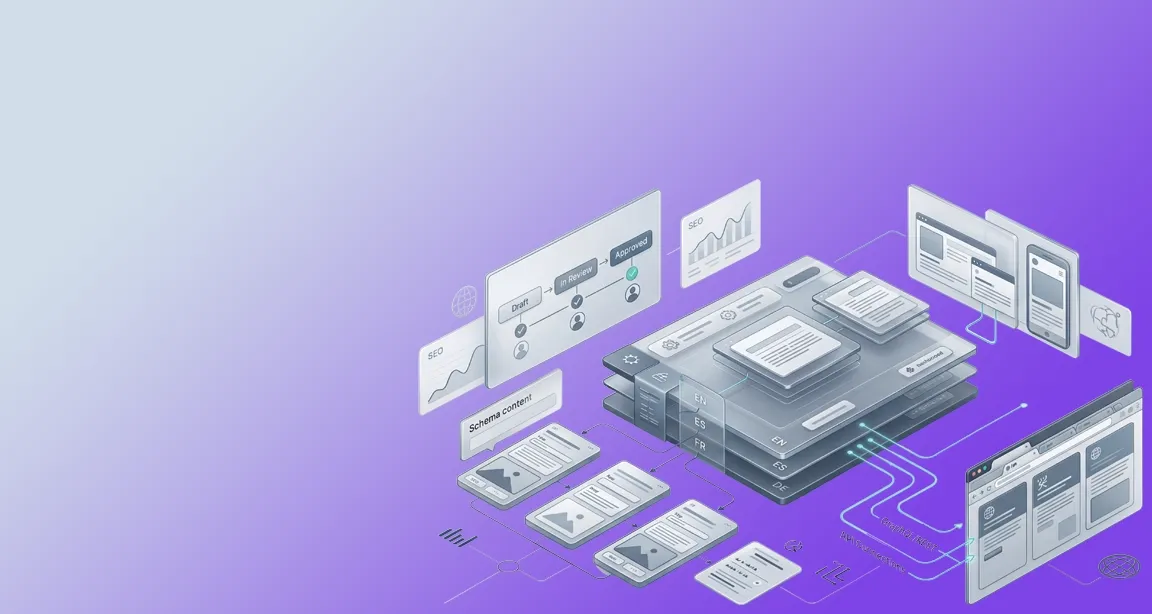
Summary
Strapi multilingual is not only about whether a CMS can store multiple languages. It is about building a clean structure for locales, approvals, preview and multilingual content operations.
In international projects, the real challenge is how content is organized across languages, markets, page types and teams. That is exactly where a purely technical setup differs from an operationally reliable CMS model.
When teams evaluate Strapi multilingual websites, they usually look at more than just:
- whether content can be localized
- how locale versions are created
- how preview works for each language
- how publishing and approvals are handled across multiple language versions
- how global and local content are separated
- how the model connects to a multilingual frontend such as Next.js
They also want to know:
- whether content stays consistent across all language versions
- whether it is clear which content is global and which is maintained locally
- whether workflows per market and per locale work reliably
- whether the setup can actually run in daily operations without constant rework from editorial and development teams
Strapi provides the foundation for managing content across multiple locales through its Internationalization feature. In Strapi 5, i18n is a free feature, preview connects the Content Manager to the frontend, Draft & Publish separates draft and live content, and Review Workflows remain an enterprise feature. Strapi also documents locale-specific handling in both the REST API and Document Service API.
So for international websites, the real question is not only:
Can Strapi handle multilingual content
But rather:
Is Strapi multilingual set up correctly for our content structure, governance model and editorial operations
If you want to evaluate Strapi more broadly as a CMS approach for your website or platform, our Strapi Solution is the natural next step. If you are already thinking about implementation, architecture and operations, our Strapi Agency page is also relevant.
Before we go deeper into i18n, workflows, preview and multilingual content models, it is worth taking a closer look at what multilingual websites in a headless CMS environment really require.
How to structure locales properly in Strapi multilingual projects
The most important modeling decision for multilingual websites is not:
Which language do we need first
But:
Which content is global, which is local, and which is only partially localized
That is where many later problems begin.
A clean model usually separates between:
- global content
- localized content
- market-specific variants
- reusable components
- pages with fixed or dynamic routing logic
Typical content classes
Globally identical content
Examples:
- general product logic
- core brand messaging
- technical master data
- shared modules that stay identical across markets
Language-localized content
Examples:
- headlines
- body copy
- CTA text
- meta data
- structured FAQ content
Market-specific content
Examples:
- legal notices
- regional offers
- office or team content
- currency or contact information
- country-specific case studies
That is why Strapi i18n should not be treated as a simple translation-field model. Its real operational value appears only when teams define clearly:
- what gets translated per locale
- what stays centrally managed
- what is intentionally allowed to vary by market
- which content types are suitable for localization
- which content is better separated instead of over-localized
The Internationalization feature manages multiple locales, but it does not automatically create a strong content model. It gives you the locale layer. The quality of the setup still comes from the modeling decisions you make. This interpretation follows directly from how Strapi documents locale management and locale-specific API behavior.
Why consistency across language versions is often the real problem
Many international CMS setups do not fail because translation is impossible. They fail because consistency across language versions and page types is weak.
Typical symptoms include:
- the German page has three modules while the English one has five
- meta data is maintained in some locales but not others
- CTA elements are missing in selected language versions
- relationships to reference content are inconsistent across locales
- preview only works well for the default language
- global changes accidentally overwrite local variants
This is not only a content problem. It is an operational problem too:
- quality drops
- maintenance effort increases
- approvals take longer
- frontend issues become more likely
- teams lose confidence in the setup
For Strapi multilingual websites, consistency has to apply not only to text, but also to structure, relations, completeness and ownership.
A useful model therefore includes rules such as:
- the same page types follow the same structure
- required fields stay consistent across locales
- global components are maintained centrally
- local variants are intentional and limited
- preview and approval processes check not only text, but also structure and rendering
For international B2B websites, content hubs and platforms, structural consistency is often more important than the pure speed of creating translations.
Preview and publishing in multilingual Strapi setups
In a headless CMS multilingual setup, teams without reliable preview often see only raw content in the CMS, but not:
- how the page looks in the target market
- which route is actually being resolved
- whether the correct Strapi locale is being loaded
- whether related content is fully rendered
- whether modules work correctly in the target language version
The Strapi documentation on Preview describes preview as the connection between the Content Manager and the frontend so editors can see changes before publishing. For international websites, this matters because preview must work not only on the content layer, but also across locale, routing and template rendering. That is exactly where Strapi preview multiple languages becomes a real operational test.
What multilingual preview needs to do well
- load the correct language version
- resolve the correct frontend route
- keep draft content secure and controlled
- render related content in the correct language context
- make page modules, SEO fields and localizations fully reviewable
A simplified principle
Editor works on EN, DE or FR content in Strapi
-> Preview link is generated per locale
-> Frontend validates secret or token
-> Route is resolved with language context
-> Draft content for that locale is loaded
-> Page renders in the real template context
In international setups, preview is only useful if editors do not have to guess which language version they are looking at and whether it truly reflects the later live page.
How to connect Strapi multilingual with Next.js cleanly
The frontend is supportive here, but it is not the main topic. Still, the connection to a multilingual frontend such as Next.js is operationally critical.
The Next.js documentation on Internationalization describes internationalized routes and localized delivery. That makes it possible to connect Strapi multilingual CMS logic to a frontend that serves different routes, layouts or content per language or market. Especially in Strapi Next.js multilingual setups, the CMS model, routing logic and preview behavior need to work together consistently.
What matters most
- CMS locale and frontend locale must match
- routes must be clearly defined per language version
- preview must use the same URL logic as the live site
- global and local content must not be mixed accidentally in rendering
- page types must be delivered consistently per Strapi locale
Typical integration questions
- Is de in the frontend really the same as de in the CMS
- How are alternate language versions of a page connected
- Which route applies when pages vary by market
- How are draft entries loaded per locale
- How do you prevent one market from rendering another market’s content by mistake
Important
The frontend does not solve the structural complexity of the CMS model. It only makes good modeling visible or bad modeling painful.
Our Strapi with Next.js guide is the natural follow-up here.
Strapi multilingual is not just an SEO topic but a CMS operations topic
When teams talk about multilingual websites, the discussion often drifts into technical SEO.
That is understandable, but it is too narrow here.
Of course, frontend topics such as internationalized routes, alternate language versions and clean page signals matter. Next.js explicitly documents internationalized routing and localized content delivery.
But for CMS evaluation, the more important questions come first:
- How is content localized
- How do page types stay consistent
- How are approvals managed per locale
- How are global and local content separated
- How do central and local teams work together
- How does preview become usable in daily operations
That is why this guide deliberately focuses on structure, governance and editorial operations first.
Frontend internationalization matters, but it is supportive, not primary.
Typical mistakes in Strapi multilingual website setups
1. Everything gets localized even when it should not
That creates duplication, maintenance effort and inconsistency.
2. Global and local content are not clearly separated
Then market variants overwrite central content or vice versa.
3. Locale structure is defined technically but not explained operationally
Then no one knows when content should be translated and when it should be adapted strategically.
4. Preview does not fully account for language, route and relations
Then teams see a preview that looks correct but does not match the live result.
5. Approvals are not handled per locale
Then nobody knows whether all language versions are truly complete and approved.
6. Roles and permissions are not aligned with international teams
Then either too many people can change global content or local teams are blocked unnecessarily.
7. Page types drift apart between languages
Then the setup gradually becomes difficult to manage editorially.
What a practical Strapi multilingual setup can look like
A strong setup does not need to be maximally complex. It needs to be clear, understandable and usable in daily operations.
A pragmatic baseline model
Classify content
- global
- localized
- market-specific
- reusable
- campaign-specific
Define content types deliberately
- stable structures for key page types
- global modules separated from local variants
- SEO fields maintained consistently per locale
- relations used intentionally and with limits
Define responsibilities
- central editorial team
- local execution
- publisher
- SEO / marketing
- admin / development
Integrate preview cleanly
- per locale
- per route
- with draft content
- with real template rendering
Operationalize approvals
- clear status per language version
- defined ownership
- no publication by informal request
- short review in the target-market context after publishing
Simplified workflow
- A page or module is created centrally
- Locale versions are created
- Content is maintained per language
- Preview is checked for each language version
- Quality and SEO review take place
- Approval happens per locale or market
- Publishing is done by a defined role
This model is intentionally simple. Larger setups often add extra rules for market variants, staged releases or more complex approval chains.
When Strapi multilingual is a strong fit for international websites
Strapi becomes especially interesting when companies want to do more than just publish multilingual websites. It is a strong option when they want to run them in a controlled way.
Strapi multilingual often fits well when:
- content should be structured and modular
- multiple language versions need to be maintained cleanly
- global and local teams work together
- approvals and roles need to be clearly organized
- frontend preview matters
- markets, languages and page types need to stay consistent
- a headless frontend such as Next.js is planned
Strapi should be evaluated more carefully when:
- only very simple translation logic is needed
- the team maintains very little structured content
- ownership for international content is unclear
- the main bottleneck is process discipline rather than CMS functionality
- a very simple classic editorial experience matters more than flexible modeling
Strapi’s official documentation clearly shows that i18n, preview and Draft & Publish provide important building blocks. Whether those turn into a strong international setup depends on modeling, governance and team logic.
Where this guide fits inside the cluster
If you are evaluating Strapi multilingual websites and international content models, the most relevant pages in the cluster are:
A useful reading path is often:
- Strapi multilingual: for locale structure, governance and multilingual editorial operations
- Strapi with Next.js: for frontend architecture, preview and delivery
- Strapi Agency / Strapi Solution: for the broader evaluation and implementation decision