React agency for high-performance frontends & clear architecture
We modernize React codebases for better performance, DX, and more stable releases.
For teams that want to evolve React frontends
into setups that are faster, more stable, and easier to scale.
Trusted by clients across the DACH region
Scaled React setups in SaaS, insurance, media & events

Frequently asked questions to a React agency
Answers on architecture, state strategies, performance, SEO and team enablement. Project specifics are best discussed in a 30-minute tech check — incl. first recommendations.

How much does a React project cost?
Depends on starting point and goals. Common entry: code/performance audit (fixed price), then two-week sprints or retainer. Ballparks (non-binding): Audit €1.2–3.5k, refactoring sprint €8–15k, MVP 6–10 weeks. We plan with a 30/60/90-day roadmap, clear DoD and measurable KPIs (e.g., INP/LCP targets, defect rate, lead time).
What does the process look like — from kick-off to go-live?
- Discovery & codebase scan (profiling, bundle/render costs, DX bottlenecks)
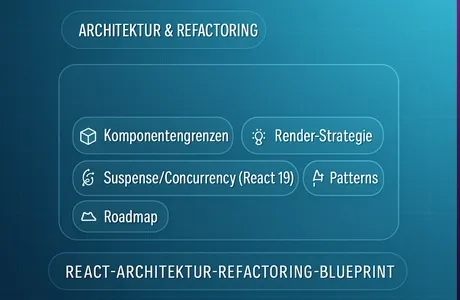
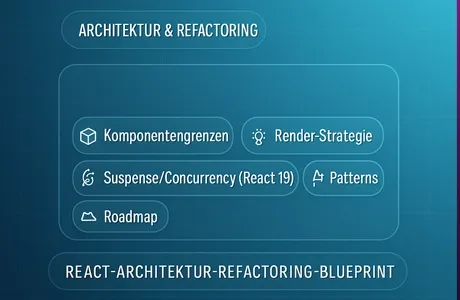
- Blueprint (component boundaries, state strategy, data layer, test plan)
- Hardening sprint (top levers: INP/LCP, architecture fixes, CI)
- Feature delivery (canary rollouts, observability, A/B tests)
First improvements typically go live in 2–4 weeks; an MVP in 6–10 weeks.
Is upgrading to React 19 worth it?
Often yes. React 19 brings Actions, useActionState, useOptimistic, the use API (suspends during render), new form APIs in react-dom (useFormStatus), ref as a prop, <Context> as provider, improved hydration error diffs and stable RSC. Approach: check compatibility, enable Transitions/Actions step-by-step, guard with INP/LCP watchers, rollout via feature flags
SSR/SSG or is CSR enough?
We decide per page type/flow:
- CSR for internal/app-only UIs (no SEO need, heavy interaction)
- SSR/streaming for SEO-relevant, personalized or frequently updated content
- SSG/ISR for landing/docs/category with controlled freshness
We build a rendering matrix (SEO, freshness, personalization, cost) and set cache/revalidation rules.
What’s the right state management (React Query, RTK, Zustand …)?
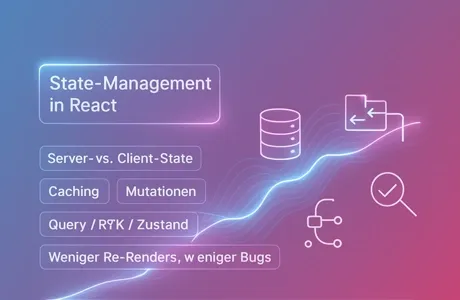
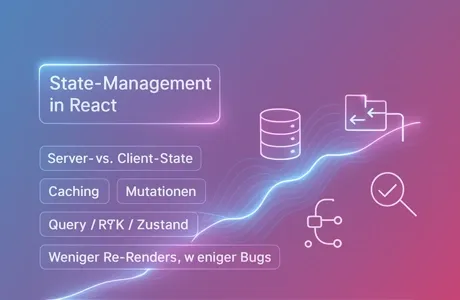
Server state ≠ client state.
- Server state: React Query (cache, revalidate, mutations)
- Client state: Zustand/RTK depending on complexity; forms separate (controller/schema)
Guardrails: minimal re-renders, selector-based access, decoupled side-effects, clear cross-cutting concerns (auth/feature flags/tracking).
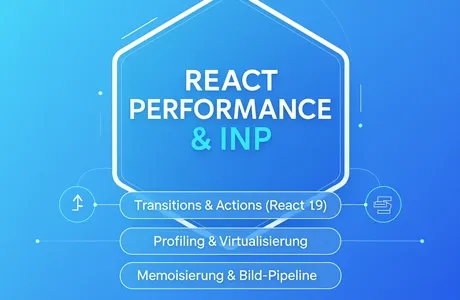
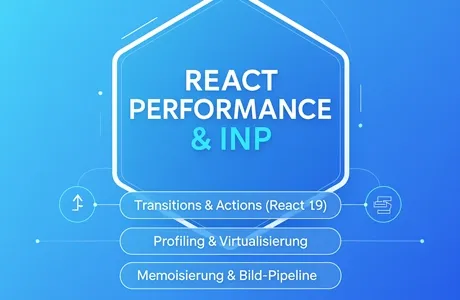
How do you improve INP/LCP in practice?
- LCP: correct sizes for hero image, AVIF/WebP, single priority, preconnect/preload, critical CSS
- INP: event decoupling (transitions), selective/lazy hydration, virtualization, debounce/throttle, split heavy listeners
- JS budget: code-splitting, no heavy UI libs above the fold, strict third-party budget
Measurement: profiling + RUM (targets: INP P75 < 200 ms, LCP < 2.5 s).
Does SEO work with React?
Yes — with the right rendering strategy. Essentials: meaningful routes, meta/schema server-side or pre-rendered, internal linking, i18n/hreflang, fast CWV. For content teams we integrate headless CMS (previews, roles/permissions) and clean content modeling.
You can find more technical details in our React consulting solution.
How do you measure success — beyond CWV?
A KPI set per goal:
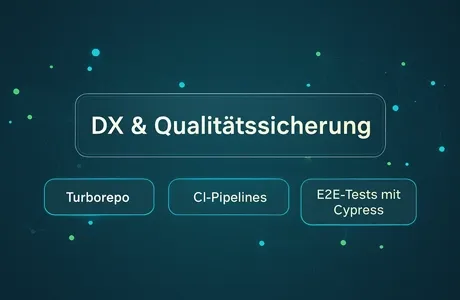
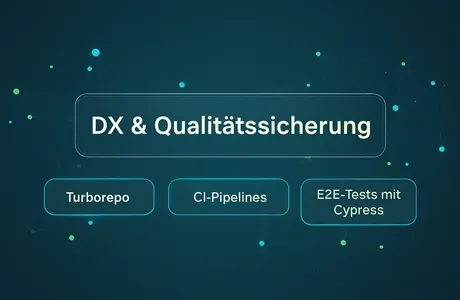
- Productivity/DX: lead time, deployment frequency, change failure rate
- Quality: defect rate, e2e pass rate, error budget
- Business: conversion/CTR, time-to-publish, SEO visibility
We report monthly, prioritize by impact/effort, and tie tasks to metric goals (e.g., INP −30 %, lead time −20 %).